
Parliament: Sovereignty and Limitation

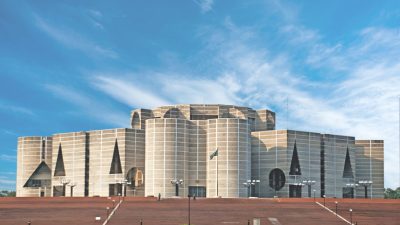
The issue of the sovereignty of Parliament has long been the centre of debate in Bangladesh, in and outside Parliament. Particularly, after the passing of the 8th Amendment judgement in 1989, whereby the Appellate Division of the Supreme Court of Bangladesh had struck down the Constitution (Eighth Amendment) Act, 1988, a debate had erupted in Parliament, mainly claiming that Parliament’s power to make law was unlimited. At that time. I wrote an article, ‘House of the Nation: Is its power unlimited?’ in 42 DLR (1990), Journal 45. The current one, however, has straightforwardly addressed the issue in the light of the history of parliament and as per the provisions of the Constitution of the People’s Republic of Bangladesh.
SOVEREIGNTY IN THE CONTEXT OF THE BANGLADESH CONSTITUTION
Article 65(1) of the Constitution of the People’s Republic of Bangladesh, which has created Parliament, reads that “There shall be a Parliament for Bangladesh (to be known as the House of the Nation) in which, subject to the provisions of this Constitution, shall be vested the legislative powers of the Republic.”
Therefore, (1) Parliament, like the other two branches, is a creation of the Constitution; (2) the legislative powers belong to the Republic; (3) this power has been “vested” in the Parliament, i.e., the legislative power is not inherent in it; (4) the power to make law is “subject to the provisions of the Constitution”; and (5) the word “this” in Article 65(1) excludes reference to any other Constitution for delineating its power.
Article 7, in subarticle (2), says that “This Constitution is, as the solemn expression of the will of the people, the supreme law of the Republic, and if any other law is inconsistent with this Constitution, that other law shall, to the extent of the inconsistency, be void.”
Therefore, a Parliament with unlimited power to make law, or to make any law inconsistent with this Constitution, has neither been established by, nor contemplated in, the Constitution. While its powers cannot be claimed or denied with reference to any constitution, other than that of the PRB.
SOVEREIGNTY OF PARLIAMENT: HISTORY AND EVOLUATION
So far as the Parliament of the UK is concerned, the expression ‘sovereignty of Parliament’ signifies its absolute independence from any sort of interference from the monarch. It has its origin and evolution, as an attribute of the legislative organ, in the UK. This has been made conspicuous and given perpetuity by enacting the Bill of Rights, 1689. Section 1 of it declares that the king’s power to dispense with any law or to suspend any law or to execute any law without consent of parliament is illegal. Section 4 has prohibited levying money (taxation) by the king without the grant of parliament; section 8 ordains that the election of members of parliament ought to be free, while section 9 enacts that the freedom of speech and debates or proceedings in parliament ought not to be impeached or questioned in any court or place out of parliament.
The Constitution of Bangladesh has made similar provisions in Article 83 that prohibit taxation except by or under an Act of Parliament, as has been done by section 4, while Article 78 grants similar freedom and immunity to the members of Parliament and its proceedings as granted by section 9 of the Bill of Rights, 1689. Sovereignty of Parliament has been ensured to the Parliament in Bangladesh, in the sense as it has been contemplated in the Bills of Rights, 1689. But there is no written constitution in the UK; therefore, there is no supremacy clause as has been entrenched in Article 7(2) of the Constitution of the PRB. So, the extent of limitation in Bangladesh is wider than in the UK, and the opportun
COLONIES AND DOMINIONS: THE EVOLUTION OF THE CONCEPT
The question of the sovereignty of the parliaments of the Commonwealth countries under British rule had, however, arisen in a different context at the time of granting independence to them because the parliament of the UK possessed the power to make laws for those countries. There cannot be two parliaments having concurrent powers to make laws in respect of a territory. One way to address this issue was for the UK parliament to enact a law abolishing its power to make laws for those colonies. But the problem here was that a parliament cannot bind its successors [which is an aspect of the sovereignty of parliament.]
However, as a prudent measure, the parliament of the UK had enacted the Colonial Laws Validity Act, 1865. The objects and reasons were that “doubts have been entertained respecting the validity of diverse laws enacted or purporting to have been enacted by the legislature of Her Majesty’s colonies and respecting the powers of such legislatures, and it is expedient that such doubt should be removed.” Besides, to make it further clear, section 3 of the Act stipulates that “No Colonial Law shall be or be deemed to have been void or inoperative on the Ground of Repugnancy to the Law of England.”
In a succession thereof, the Statute of Westminster, 1931, was enacted by the UK parliament, whereby the Colonial Laws Validity Act, 1865, was substituted and was made inapplicable thenceforth. Section 2(2) of the Statute reiterates that “No law and no provision of any law made after commencement of this Act by the Parliament of a Dominion shall be void or be inoperative on the ground that it is repugnant to the law of England.” Section 3 states that “It is hereby declared and enacted that the Parliament of a Dominion has full power to make laws having extra-territorial operation.” Then, section 4 enacts that “No Act of the Parliament of the United Kingdom passed after commencement of this Act shall extend, or be deemed to extend, to a Dominion as part of the law of that Dominion.” This Act was applicable to Canada, Australia, New Zealand, South Africa, the Irish Free State and Newfoundland.
However, in respect of the Dominion of India, section 6(4) of the Indian Independence Act, 1947, declares that “No Act of Parliament of the United Kingdom passed on or after the appointed day shall extend, or be deemed to extend, to either of the new Dominions as part of that Dominion unless it is extended thereto by a law of the Legislature of the Dominions.” Here, Dominion refers to India and Pakistan, to whom independence has been granted under the Indian Independence Act. 1947, while the appointed day means 15th August, 1947.
The historical background of the origin and evolution of the concept of ‘sovereignty’ respecting Parliament makes it clear that the expression ‘sovereignty of Parliament’ lies in its power to make law as the supreme law-making body and independently of any interference from the King, in the case of the British Parliament, and from the British Parliament, in the case of the colonies or dominions to whom independence has been granted by it.
LIMITATION TO THE SOVEREIGNTY OF PARLIAMENT: FAILURE OF DEMOCRACY
However, the limitation to the sovereignty of Parliament, in the context of Bangladesh, seems to lie in clause (b) of Article 70 of the Constitution, which stipulates that the seat of a person elected as a member and nominated by a party shall be vacated “if he votes in Parliament against that party”. The bar imposed in respect of a member elected as a party candidate is absolute, although he takes the same oath as an independent member does. But, apparently, discrimination has been made between them by curtailing the voting right of a party-nominated MP in Parliament in the manner laid down in clause (b) of Article 70. Consequently, a party MP cannot vote against the party line if a motion is brought in Parliament to ascertain if the Prime Minister retains the support of a majority of the members of Parliament for the purpose of Article 57(2).
Article 57(2), which guarantees a democratic polity, stipulates that “If the Prime Minister ceases to retain the support of a majority of the members of Parliament, he shall either resign his office or advise the President in writing to dissolve Parliament.”
So, clause (b) of Article 70 contradicts the provisions of Article 57(2) and has made it a total nullity and preposterous. It denies and obstructs the constitutional process to secure the change of a regime that the people may consider inefficient or otherwise unfit to continue. Agitation in the street or shedding of blood cannot be the rule, nor should these be the alternatives to Article 57(2); and all these could have been obviated by way of voting in Parliament on a ‘no confidence motion’ as per provisions of Article 57(2). Of course that will require the omission of (b) of Article 70.
The vice of clause (b) of Article 70 alone is enough to ridicule and render ineffective all other provisions of the Constitution, being the embodiment of the solemn will of the people.
Indeed, the lessons learned from history cannot allow its repetition. Therefore, this fatal wound inflicted in the Constitution by clause (b) of Article 70 may now be cured by the BNP-led government, having the required majority in the 13th Parliament, as another historic contribution made earlier by the 13th amendment during its tenure in 1996.